 When you light the center of the fireworks music candle with a wooden stick, a flame appears that lights up the candle on the leaves in a sparkling fashion. In addition to this, it plays a Happy Birthday song
Wednesday, February 27, 2008
Fireworks Music Candle
When you light the center of the fireworks music candle with a wooden stick, a flame appears that lights up the candle on the leaves in a sparkling fashion. In addition to this, it plays a Happy Birthday song
Saturday, February 16, 2008
Feb 14,China Shanshui Warehouse explosive

GUANGZHOU, Feb. 15 (Xinhua) -- Firefighters in south China's Guangdong Province began to clear up the debris as explosions caused by fireworks stored in 20 warehouses in Foshan City waned on Friday.
Five people, including four warehouse guards, were questioned by police in connection with the incident, said a spokesman for Foshan's Sanshui District Communist Party of China (CPC) committee.
The State Administration of Work Safety has sent two commissioners and an expert to Sanshui to investigate.
Zhou Wei, a warehouse worker, told Xinhua the buildings have been used to store nothing other than fireworks since 2003, and electricity was never used for safety purposes. Experts said weather conditions and arson were possible causes for the explosions.
The blasts started around 3:30 a.m. on Thursday at the No. 7 building of the Yuetong Warehouse and Transport Co., a private firm based in Sanshui on the northern bank of the Pearl River. The explosions lasted more than 30 hours and also set a neighboring woods on fire, a Foshan government official said.
Only two people suffered slight bruises from broken glasses
Tuesday, July 10, 2007


Thursday, November 02, 2006
A Radical opinion
Boycott Chinese fireworks
--------------------------------------------------------------------------------
Posted: August 6, 2001
1:00 a.m. Eastern
WASHINGTON — Ten-year-old Zhang Yanhong knew that if she refused her teacher's orders, she could be forced to pay a fine or kneel on the classroom floor for hours. So the girl obeyed her teacher – and paid with her life.
What were the teacher's orders? To manufacture fireworks – fireworks that exploded, killing 42 people, most of them 3rd- and 4th-graders.
Last month I announced my campaign to boycott Chinese fireworks for celebrations next July 4.
Since then, I've learned the idea is better and more needed than ever.
It turns out Chinese fireworks made by forced child labor have come under investigation by the U.S. Department of Labor, according to Carl Olson, chairman of State Department Watch, a foreign policy watchdog group based in Washington.
The massive use of Chinese schoolchildren in the manufacturing of fireworks destined for the United States and, ironically, patriotic celebrations of freedom and justice, came to light following the explosion that killed 42 at the elementary school in Jiangxi province.
The children were tasked with daily producing 1,000 firecrackers each and the money from the business went to school officials.
The government blamed the horror on a lone madman. But relatives of the children complained for three years about school officials forcing their children to assemble fireworks during and after school.
State Department Watch brought the incident to the attention of the Labor Department.
Purchases by the federal government of goods made by forced child labor were banned earlier this year. The Department of Labor is responsible for identifying offending countries and products. To date the list includes only 11 products from two countries – Burma and Pakistan.
"This terrible abuse of schoolchildren cannot be permitted to continue," said Olson. "The federal government and the rest of the nation must refuse to support such forced labor."
Widespread use of schools for forced labor in China was described in the New China News Agency last year. According to a Los Angeles Times report from last March, 91 percent, or about 620,000, of China's secondary schools have some business run by the government officials, yielding $15 billion – nearly equal to the central government's entire education budget.
What does all this have to do with July 4 and fireworks in the United States?
Every year – at least in areas where selling fireworks is still legal – groups like churches, service clubs, schools, etc. raise money by selling fireworks to the public.
In 2001 for instance, fireworks sales totaled an estimated $650 million, according to the American Pyrotechnics Association.
So what's wrong with selling fireworks? Am I worried about accidents?
Actually, no. In fact, while sales of fireworks are way up, fireworks-related injuries are way down – falling over 86 percent in the last 24 years.
No, my concern about all the fireworks sales in America is centered around where those pyrotechnic devices are manufactured – in China.
How can this nation celebrate its independence every year by supporting the evil empire in Beijing?
Every single fireworks package I see – at least those available to ordinary consumers – is marked "made in China." While there may be alternatives, I have never seen any.
So I want to set off some rhetorical fireworks here while we still have time to prepare for July 4, 2002. Let's boycott Chinese fireworks. Let's say no to distributing Chinese-made fireworks in the U.S. Let's celebrate Independence Day by supporting independence and freedom throughout the world – including China.
By the way, don't count on the Labor Department to do the right thing on this fireworks issue. Let's remember who is in charge as secretary – Elaine Chao, noted for her cozy ties to the Beijing leadership.
If you want to sound off in protest of the child labor in China, Olson advises the point of contact is: Maureen Jaffe, acting director, International Child Labor Program, Bureau of International Labor Affairs, U.S. Department of Labor, Room N-2431, Washington, DC 20210.
But I think it's time to take matters into our own hands. Don't wait for the government to act. Maybe it's not a big step – a dramatic step – but I think it's time to start reclaiming our national soul. A good first step would be for charitable organizations across America to swear off the sales of Chinese-made fireworks next summer.
Are you with me? If so, I'll keep hammering away at this theme and reminding you of the latest developments through next Independence Day.
--------------------------------------------------------------------------------
Related offer:
"The China Threat," Bill Gertz's book about how People's Republic targets America, is available in WorldNetDaily's online store.
--------------------------------------------------------------------------------
Joseph Farah is founder, editor and CEO of WND and a nationally syndicated columnist with Creators Syndicate. His latest book is "Taking America Back." He also edits the weekly online intelligence newsletter Joseph Farah's G2 Bulletin, in which he utilizes his sources developed over 30 years in the news business.
--------------------------------------------------------------------------------
Posted: August 6, 2001
1:00 a.m. Eastern
WASHINGTON — Ten-year-old Zhang Yanhong knew that if she refused her teacher's orders, she could be forced to pay a fine or kneel on the classroom floor for hours. So the girl obeyed her teacher – and paid with her life.
What were the teacher's orders? To manufacture fireworks – fireworks that exploded, killing 42 people, most of them 3rd- and 4th-graders.
Last month I announced my campaign to boycott Chinese fireworks for celebrations next July 4.
Since then, I've learned the idea is better and more needed than ever.
It turns out Chinese fireworks made by forced child labor have come under investigation by the U.S. Department of Labor, according to Carl Olson, chairman of State Department Watch, a foreign policy watchdog group based in Washington.
The massive use of Chinese schoolchildren in the manufacturing of fireworks destined for the United States and, ironically, patriotic celebrations of freedom and justice, came to light following the explosion that killed 42 at the elementary school in Jiangxi province.
The children were tasked with daily producing 1,000 firecrackers each and the money from the business went to school officials.
The government blamed the horror on a lone madman. But relatives of the children complained for three years about school officials forcing their children to assemble fireworks during and after school.
State Department Watch brought the incident to the attention of the Labor Department.
Purchases by the federal government of goods made by forced child labor were banned earlier this year. The Department of Labor is responsible for identifying offending countries and products. To date the list includes only 11 products from two countries – Burma and Pakistan.
"This terrible abuse of schoolchildren cannot be permitted to continue," said Olson. "The federal government and the rest of the nation must refuse to support such forced labor."
Widespread use of schools for forced labor in China was described in the New China News Agency last year. According to a Los Angeles Times report from last March, 91 percent, or about 620,000, of China's secondary schools have some business run by the government officials, yielding $15 billion – nearly equal to the central government's entire education budget.
What does all this have to do with July 4 and fireworks in the United States?
Every year – at least in areas where selling fireworks is still legal – groups like churches, service clubs, schools, etc. raise money by selling fireworks to the public.
In 2001 for instance, fireworks sales totaled an estimated $650 million, according to the American Pyrotechnics Association.
So what's wrong with selling fireworks? Am I worried about accidents?
Actually, no. In fact, while sales of fireworks are way up, fireworks-related injuries are way down – falling over 86 percent in the last 24 years.
No, my concern about all the fireworks sales in America is centered around where those pyrotechnic devices are manufactured – in China.
How can this nation celebrate its independence every year by supporting the evil empire in Beijing?
Every single fireworks package I see – at least those available to ordinary consumers – is marked "made in China." While there may be alternatives, I have never seen any.
So I want to set off some rhetorical fireworks here while we still have time to prepare for July 4, 2002. Let's boycott Chinese fireworks. Let's say no to distributing Chinese-made fireworks in the U.S. Let's celebrate Independence Day by supporting independence and freedom throughout the world – including China.
By the way, don't count on the Labor Department to do the right thing on this fireworks issue. Let's remember who is in charge as secretary – Elaine Chao, noted for her cozy ties to the Beijing leadership.
If you want to sound off in protest of the child labor in China, Olson advises the point of contact is: Maureen Jaffe, acting director, International Child Labor Program, Bureau of International Labor Affairs, U.S. Department of Labor, Room N-2431, Washington, DC 20210.
But I think it's time to take matters into our own hands. Don't wait for the government to act. Maybe it's not a big step – a dramatic step – but I think it's time to start reclaiming our national soul. A good first step would be for charitable organizations across America to swear off the sales of Chinese-made fireworks next summer.
Are you with me? If so, I'll keep hammering away at this theme and reminding you of the latest developments through next Independence Day.
--------------------------------------------------------------------------------
Related offer:
"The China Threat," Bill Gertz's book about how People's Republic targets America, is available in WorldNetDaily's online store.
--------------------------------------------------------------------------------
Joseph Farah is founder, editor and CEO of WND and a nationally syndicated columnist with Creators Syndicate. His latest book is "Taking America Back." He also edits the weekly online intelligence newsletter Joseph Farah's G2 Bulletin, in which he utilizes his sources developed over 30 years in the news business.
Monday, October 02, 2006
Fireworks performance celebrates PRC 57th birthday
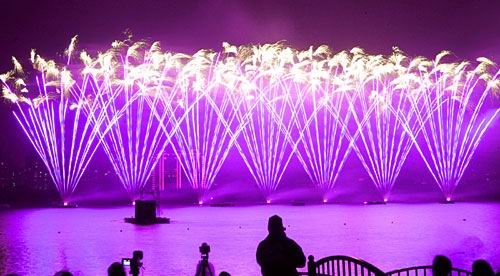


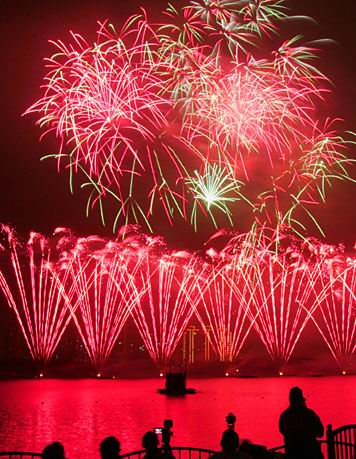
People watch the fireworks in Shanghai on Sept. 30, 2006 the eve of China's National Day to celebrate the 57th anniversary of the founding of the People's Republic of China.
People watch the fireworks in Shanghai on Sept. 30, 2006 the eve of China's National Day to celebrate the 57th anniversary of the founding of the People's Republic of China.
The fireworks in Hong Kong on Oct.1, 2006 which is the 57th anniversary of the founding of the People's Republic of China attract hundreds of thousands of HK citizens.
The fireworks in Hong Kong on Oct.1, 2006 which is the 57th anniversary of the founding of the People's Republic of China attract hundreds of thousands of HK citizens.
Monday, September 18, 2006
China Fireworks bring joy, sorrow to Sping Festival
BEIJING, Feb. 1 (Xinhuanet) -- The return of fireworks to traditional Lunar New Year celebrations brought much joy to revelers, but also sorrow to some parts of the nation.
In Beijing, where a 12-year ban on fireworks had just been lifted, explosions injured 112 people, said the State Administration of Work Safety, quoted by Wednesday's China Daily.
Seventeen people suffered serious eye injuries, and another 26 were admitted to hospital with various types of wounds.
According to the Beijing News Daily, the city's environmental protection bureau collected 458 tons of waste fireworks on Jan. 29, the first day of the Lunar New Year.
In Chongqing Municipality, southwest China, firefighters rushedto extinguish 191 fires caused by fireworks on the Lunar New Year's Eve.
About 3,000 firefighters gave up the chance to spend the holiday with their families to remain on duty.
Experts said the lifting of the ban would help preserve traditional Chinese culture. But others said the return of fireworks would lead to more serious pollution, fires, injuries and deaths.
On Sunday, an explosion in Linzhou, a city in Henan Province, central China, killed 36 people and injured 48 others.
The explosion occurred when firecrackers in a storehouse were accidentally ignited, the State Administration of Work Safety saidin a statement.
Although there were disagreements, the governments in more than100 Chinese cities lifted the ban on fireworks last year.
Beijing also lifted the ban after a survey found that 70 percent of residents felt fireworks made the holiday period more festive.
The new rules allow Beijing residents to explore fireworks all day and all night on Jan. 28, and from 7 a.m. to midnight every day from Jan. 29 to Feb. 12.
With the aim of ensuring safety, about 3,000 police and community officers have been sent to patrol off-limits areas such as schools, retirement homes and sites of historic relics.
In Beijing, where a 12-year ban on fireworks had just been lifted, explosions injured 112 people, said the State Administration of Work Safety, quoted by Wednesday's China Daily.
Seventeen people suffered serious eye injuries, and another 26 were admitted to hospital with various types of wounds.
According to the Beijing News Daily, the city's environmental protection bureau collected 458 tons of waste fireworks on Jan. 29, the first day of the Lunar New Year.
In Chongqing Municipality, southwest China, firefighters rushedto extinguish 191 fires caused by fireworks on the Lunar New Year's Eve.
About 3,000 firefighters gave up the chance to spend the holiday with their families to remain on duty.
Experts said the lifting of the ban would help preserve traditional Chinese culture. But others said the return of fireworks would lead to more serious pollution, fires, injuries and deaths.
On Sunday, an explosion in Linzhou, a city in Henan Province, central China, killed 36 people and injured 48 others.
The explosion occurred when firecrackers in a storehouse were accidentally ignited, the State Administration of Work Safety saidin a statement.
Although there were disagreements, the governments in more than100 Chinese cities lifted the ban on fireworks last year.
Beijing also lifted the ban after a survey found that 70 percent of residents felt fireworks made the holiday period more festive.
The new rules allow Beijing residents to explore fireworks all day and all night on Jan. 28, and from 7 a.m. to midnight every day from Jan. 29 to Feb. 12.
With the aim of ensuring safety, about 3,000 police and community officers have been sent to patrol off-limits areas such as schools, retirement homes and sites of historic relics.
Wednesday, September 13, 2006
confetti is going to replace fireworks?
All our confetti products are made of environment-friendly tissue or mylar material. With the feature of Easy-to-Use and Safe-to-Enjoy, our confetti products are regarded as A New Age of Flameless Fireworks! There is no need for our distributors to take the pain to obtain a pyrotechnic license. These fantastic confetti products will bring you amazing effects on all celebration occasions
Wednesday, September 06, 2006
The Ultimate Rockets
It's a pyrotechnist's dream come true: 55,000 rockets blasting off at the same time. University of Plymouth's Roy Lowry chats about his attempt to break the simultaneous-rocket-firing world record. Wired News interview by Nigel Watson.
In mid-August, a U.K. chemistry professor attempted a Guinness World Record by launching 55,000 fireworks at the same time.
Roy Lowry of the University of Plymouth is waiting for official confirmation of his record, but before he lit the fuses, he told Wired News about the preparations.
Wired News: What type of rockets are you using?
Roy Lowry: Our rockets are quite small -- they are 7 inches long. They are standard rockets that you can buy in the shops; they are not special. We will be putting them into 15 specially built 4-feet-square wooden frames.
These frames have a mesh wire on the top and in the middle. The middle wire grid holds the stick of the rocket and the top grid holds the base of the rocket. The top grid is laced with something called "black match," which is basically gunpowder in a tube. This is an old-fashioned method of igniting the rockets.
We plan to get 4,000 rockets into each frame. There will be an electrical igniter for each frame and they will all be wired to a black box with the red firing button. On (Aug. 16), a team from Fantastic Fireworks and lads from the local Air Training Corps will put the fireworks in the frames. These will be counted by volunteers from Plymouth University and five bank tellers. There will be two witnesses to make sure that the rockets are counted properly, and they will decide if any re-counting is required.
WN: Do you foresee any particular problems?
Lowry: We do have several headaches. One problem is the weather: The slightest damp turns (the rockets) into duds. We are particularly vulnerable to the weather when we start stacking the rockets into their frames on the morning of the event. We have tarpaulins to cover them but this then makes it difficult for us to count the rockets.
Technically, this is not a difficult procedure, but we are dealing with rockets that amount to about a quarter ton of gunpowder all being set off at once. Since the rockets will be packed so close together -- roughly two rockets per square inch -- there is bound to be midair collisions. I'll be launching them wearing a visor and hard hat for safety reasons. There will only be me and a video camera within the 100-meter exclusion zone.
Afterwards, any rockets that do not launch will be deducted from the number we put in the frames. I figure we should launch at least 55,000. To find out if we get the record we have to submit a package of evidence, and it will take six weeks to find out if you have broken the record or not.
WN: What made you try this record attempt in particular?
Lowry: I was in a hot office marking coursework when Plymouth City Council asked me to come to a meeting to discuss this and it was a great draw.... When they asked me for ideas, I suggested going for an established record. This record had stood for eight years and was ready for knocking.
WN: Was this difficult to organize?
Lowry: The current record holder, Terry McDonald, launched 39,210 rockets in 1997 at the Battle of Flowers Moonlight Parade in the Channel Islands. I rang him up and he gave me plenty of helpful advice. He said he had planned to launch 40,000 rockets but 790 failed to ignite.
Within days of deciding to go ahead with this project, Black Cat Fireworks offered to provide the rockets. The Guinness World Records rules say that they must be individual rockets that are designed to reach an altitude of 30 meters (100 feet), and they all must take off within a five-second window. So we were given a lorry load of rockets, which amounts to about 60,000 rockets.
Another company, Fantastic Fireworks, provided the frames and fusing, and Plymouth City Council have helped organize things and fund us. The Event Services Association TESA have also worked on the risk-assessment, logistics, crowd control, health and safety issues.
In mid-August, a U.K. chemistry professor attempted a Guinness World Record by launching 55,000 fireworks at the same time.
Roy Lowry of the University of Plymouth is waiting for official confirmation of his record, but before he lit the fuses, he told Wired News about the preparations.
Wired News: What type of rockets are you using?
Roy Lowry: Our rockets are quite small -- they are 7 inches long. They are standard rockets that you can buy in the shops; they are not special. We will be putting them into 15 specially built 4-feet-square wooden frames.
These frames have a mesh wire on the top and in the middle. The middle wire grid holds the stick of the rocket and the top grid holds the base of the rocket. The top grid is laced with something called "black match," which is basically gunpowder in a tube. This is an old-fashioned method of igniting the rockets.
We plan to get 4,000 rockets into each frame. There will be an electrical igniter for each frame and they will all be wired to a black box with the red firing button. On (Aug. 16), a team from Fantastic Fireworks and lads from the local Air Training Corps will put the fireworks in the frames. These will be counted by volunteers from Plymouth University and five bank tellers. There will be two witnesses to make sure that the rockets are counted properly, and they will decide if any re-counting is required.
WN: Do you foresee any particular problems?
Lowry: We do have several headaches. One problem is the weather: The slightest damp turns (the rockets) into duds. We are particularly vulnerable to the weather when we start stacking the rockets into their frames on the morning of the event. We have tarpaulins to cover them but this then makes it difficult for us to count the rockets.
Technically, this is not a difficult procedure, but we are dealing with rockets that amount to about a quarter ton of gunpowder all being set off at once. Since the rockets will be packed so close together -- roughly two rockets per square inch -- there is bound to be midair collisions. I'll be launching them wearing a visor and hard hat for safety reasons. There will only be me and a video camera within the 100-meter exclusion zone.
Afterwards, any rockets that do not launch will be deducted from the number we put in the frames. I figure we should launch at least 55,000. To find out if we get the record we have to submit a package of evidence, and it will take six weeks to find out if you have broken the record or not.
WN: What made you try this record attempt in particular?
Lowry: I was in a hot office marking coursework when Plymouth City Council asked me to come to a meeting to discuss this and it was a great draw.... When they asked me for ideas, I suggested going for an established record. This record had stood for eight years and was ready for knocking.
WN: Was this difficult to organize?
Lowry: The current record holder, Terry McDonald, launched 39,210 rockets in 1997 at the Battle of Flowers Moonlight Parade in the Channel Islands. I rang him up and he gave me plenty of helpful advice. He said he had planned to launch 40,000 rockets but 790 failed to ignite.
Within days of deciding to go ahead with this project, Black Cat Fireworks offered to provide the rockets. The Guinness World Records rules say that they must be individual rockets that are designed to reach an altitude of 30 meters (100 feet), and they all must take off within a five-second window. So we were given a lorry load of rockets, which amounts to about 60,000 rockets.
Another company, Fantastic Fireworks, provided the frames and fusing, and Plymouth City Council have helped organize things and fund us. The Event Services Association TESA have also worked on the risk-assessment, logistics, crowd control, health and safety issues.
Tighter controls loom for public sale of fireworks
Tighter controls loom for public sale of fireworks
Auckland City's Economic Development and Sustainable Business Committee has agreed to support work being carried out by central government to address public concerns about the sale and use of fireworks.
Led by the Ministry for the Environment with the Environmental Risk Management Authority and Auckland police and fire services, a paper recommending a range of fireworks regulations and measures will be presented to the Cabinet calling for tighter controls.
Councillor Richard Northey, committee chairperson says the council supports this central government work programme and will notify the Minister for the Environment and the Minister for Auckland Issues accordingly.
"Harmful incidents from fireworks are escalating annually. The central government's work programme is all about reducing these occurrences and protecting public safety.
"We believe that appropriate changes to fireworks regulations should reduce the amount of damage to people, property and pets stemming from the deliberate misuse of fireworks that occurs every Guy Fawkes season," Mr Northey said. In response to calls of concern from community boards, police, the fire service, SPCA and other groups over the irresponsible use of fireworks, the council has agreed to another temporary ban in public space along Tamaki Drive for Guy Fawkes from 3 - 5 November 2006.
The ban covers all beaches and parks along Tamaki Drive - Watene Reserve, Okahu Bay, Orakei Domain, Whenua Rangatira (Bastion Point), Michael Joseph Savage Memorial, Selwyn Domain, Kohimarama Beach, Vellenoweth Green, St Heliers Bay Beach, Ladies Bay and Achilles Point.
"We don't want to stop people having fun and celebrating Guy Fawkes but we do have a responsibility to minimise the rise of injuries and the impact on animals," says Mr Northey.
The ban does not apply to fireworks on private property.
Auckland City's Economic Development and Sustainable Business Committee has agreed to support work being carried out by central government to address public concerns about the sale and use of fireworks.
Led by the Ministry for the Environment with the Environmental Risk Management Authority and Auckland police and fire services, a paper recommending a range of fireworks regulations and measures will be presented to the Cabinet calling for tighter controls.
Councillor Richard Northey, committee chairperson says the council supports this central government work programme and will notify the Minister for the Environment and the Minister for Auckland Issues accordingly.
"Harmful incidents from fireworks are escalating annually. The central government's work programme is all about reducing these occurrences and protecting public safety.
"We believe that appropriate changes to fireworks regulations should reduce the amount of damage to people, property and pets stemming from the deliberate misuse of fireworks that occurs every Guy Fawkes season," Mr Northey said. In response to calls of concern from community boards, police, the fire service, SPCA and other groups over the irresponsible use of fireworks, the council has agreed to another temporary ban in public space along Tamaki Drive for Guy Fawkes from 3 - 5 November 2006.
The ban covers all beaches and parks along Tamaki Drive - Watene Reserve, Okahu Bay, Orakei Domain, Whenua Rangatira (Bastion Point), Michael Joseph Savage Memorial, Selwyn Domain, Kohimarama Beach, Vellenoweth Green, St Heliers Bay Beach, Ladies Bay and Achilles Point.
"We don't want to stop people having fun and celebrating Guy Fawkes but we do have a responsibility to minimise the rise of injuries and the impact on animals," says Mr Northey.
The ban does not apply to fireworks on private property.
Friday, July 21, 2006
Chemistry of Firework Colors
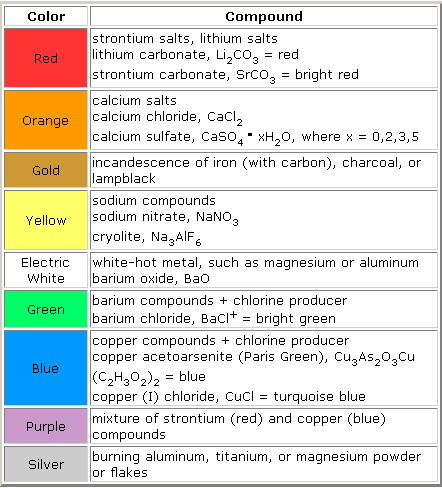
Chemistry of Firework Colors
A Marriage of Art and Science
Creating firework colors is a complex endeavor, requiring considerable art and application of physical science. Excluding propellants or special effects, the points of light ejected from fireworks, termed 'stars', generally require an oxygen-producer, fuel, binder (to keep everything where it needs to be), and color producer. There are two main mechanisms of color production in fireworks, incandescence and luminescence.
Incandescence
Incandescence is light produced from heat. Heat causes a substance to become hot and glow, initially emitting infrared, then red, orange, yellow, and white light as it becomes increasingly hotter. When the temperature of a firework is controlled, the glow of components, such as charcoal, can be manipulated to be the desired color (temperature) at the proper time. Metals, such as aluminum, magnesium, and titanium, burn very brightly and are useful for increasing the temperature of the firework.
Luminescence
Luminescence is light produced using energy sources other than heat. Sometimes luminescence is called 'cold light', because it can occur at room temperature and cooler temperatures. To produce luminescence, energy is absorbed by an electron of an atom or molecule, causing it to become excited, but unstable. When the electron returns to a lower energy state the energy is released in the form of a photon (light). The energy of the photon determines its wavelength or color.
Sometimes the salts needed to produce the desired color are unstable. Barium chloride (green) is unstable at room temperatures, so barium must be combined with a more stable compound (e.g., chlorinated rubber). In this case, the chlorine is released in the heat of the burning of the pyrotechnic composition, to then form barium chloride and produce the green color. Copper chloride (blue), on the other hand, is unstable at high temperatures, so the firework cannot get too hot, yet must be bright enough to be seen.
Quality
Pure colors require pure ingredients. Even trace amounts of sodium impurities (yellow-orange) are sufficient to overpower or alter other colors. Careful formulation is required so that too much smoke or residue doesn't mask the color. With fireworks, as with other things, cost often relates to quality. Skill of the manufacturer and date the firework was produced greatly affect the final display (or lack thereof).
Color Compound
Red strontium salts, lithium salts
lithium carbonate, Li2CO3 = red
strontium carbonate, SrCO3 = bright red
Orange calcium salts
calcium chloride, CaCl2
calcium sulfate, CaSO4·xH2O, where x = 0,2,3,5
Gold incandescence of iron (with carbon), charcoal, or lampblack
Yellow sodium compounds
sodium nitrate, NaNO3
cryolite, Na3AlF6
Electric White white-hot metal, such as magnesium or aluminum
barium oxide, BaO
Green barium compounds + chlorine producer
barium chloride, BaCl+ = bright green
Blue copper compounds + chlorine producer
copper acetoarsenite (Paris Green), Cu3As2O3Cu(C2H3O2)2 = blue
copper (I) chloride, CuCl = turquoise blue
Purple mixture of strontium (red) and copper (blue) compounds
Silver burning aluminum, titanium, or magnesium powder or flakes
Wednesday, July 19, 2006
China Fireworks
It is a tradition in China to welcome the New Year with fireworks. At midnight, the sky is lit up by fireworks, which symbolize the sending out of the old and the ushering in the new.
Firecrackers are set off as soon as the New Year arrives. You can hear or see firecrackers everywhere and this usually lasts for a few hours. Some people continue to play firecrackers occasionally throughout the first half of the first month. Traditionally fireworks are the sign of getting rid of the old and welcoming the new. However, fireworks are now banned in China, so this tradition is history.
Chinese fireworks are special and they are produced on a commercial scale. Chinese firecrackers are exported to all parts of the world. The firecrackers called stars are contained in nearly every firework and burn in the sky to produce the effect. These stars are rolled in special drums or pressed into small cylinders. Stars in a shell are usually considered the most impressive firework in a display. They produce big bursts of color in the sky. Shells are made in 2 halves and then closed together. A finished 300mm shell will fire about 300 meters into the sky and burst before burning for more than 20 seconds.
China's fireworks industry suffers hundreds of deaths every year in fires and explosions. The industry employs thousands of people, often in poor rural areas, who do much of the work by hand. The death rate keeps soaring despite repeated government promises to tighten safety. The fatality rate usually surges as producers rush to fill orders for the Lunar New Year, which comes in January. Chinese celebrate by setting off billions of firecrackers.
The government has said that it would close fireworks factories that lack modern equipment and ban production in homes, but it is not clear how effectively those restrictions can be enforced.
Firecrackers are set off as soon as the New Year arrives. You can hear or see firecrackers everywhere and this usually lasts for a few hours. Some people continue to play firecrackers occasionally throughout the first half of the first month. Traditionally fireworks are the sign of getting rid of the old and welcoming the new. However, fireworks are now banned in China, so this tradition is history.
Chinese fireworks are special and they are produced on a commercial scale. Chinese firecrackers are exported to all parts of the world. The firecrackers called stars are contained in nearly every firework and burn in the sky to produce the effect. These stars are rolled in special drums or pressed into small cylinders. Stars in a shell are usually considered the most impressive firework in a display. They produce big bursts of color in the sky. Shells are made in 2 halves and then closed together. A finished 300mm shell will fire about 300 meters into the sky and burst before burning for more than 20 seconds.
China's fireworks industry suffers hundreds of deaths every year in fires and explosions. The industry employs thousands of people, often in poor rural areas, who do much of the work by hand. The death rate keeps soaring despite repeated government promises to tighten safety. The fatality rate usually surges as producers rush to fill orders for the Lunar New Year, which comes in January. Chinese celebrate by setting off billions of firecrackers.
The government has said that it would close fireworks factories that lack modern equipment and ban production in homes, but it is not clear how effectively those restrictions can be enforced.
Tuesday, July 18, 2006
Fireworks industry gets banged up
pyrotechnics operators like Jim Souza, the job has always been a balance of work and fun, preparation and payoff.
But in recent years, what had been a cool way of helping communities celebrate has turned taxing and burdensome. Industry leaders say this has been the most challenging Fourth of July season in memory.
One of the most pressing concerns has been the lack of shipping carriers transporting fireworks from overseas manufacturers. All but one has halted shipments of large fireworks following a recent fire and explosion aboard a liner carrying a shipment of fireworks.
In addition, the events of Sept. 11, 2001, have weighed heavily on the industry, whose explosives have received the same level of scrutiny applied to other industries dealing with dangerous materials. Insurance premiums have also jumped sharply because of safety concerns.
Despite the recent travails, this year’s fireworks shows are expected to go off without a hitch. But pyrotechnicians are worried about future shows.
“ We’re here to light up the sky and make everyone happy to celebrate the Fourth of July, but it’s just a tough time for us, ” said Souza, owner of Pyro Spectaculars and a fifth-generation pyrotechnician. “ It’s become a lot more expensive and difficult to put (the shows ) on. ”
For one thing, his company and others were having a hard time getting their hands on fireworks, most of which are manufactured in China. The flow of supplies slowed after a March 21 explosion aboard the Hyundai Fortune, a container ship that was traveling through the Indian Ocean from Asia to Europe. The cause of the fire has yet to be determined, but the presence of fireworks led Hyundai and five other shipping companies to place a moratorium on the transport of large fireworks.
Only one company, Maersk, is shipping public-display fireworks explosives. The sudden turn of events caused a great amount of consternation among display operators, who were forced to reroute shipments and pray for their arrival in time.
Some bought supplies from bigger rivals with large inventories while others, like John Weiter, the owner of Gateway Fireworks Displays in St. Louis, waited it out. Weiter said his shipment arrived a couple of weeks ago. Normally it would have arrived by April.
Bengt Henriksen, a president of Quality Logistics, a San Carlos fireworks importer, said there was no evidence the Hyundai explosion was caused by fireworks. He said an investigation he commissioned found the fire began below deck, while the fireworks were stored on the top of the ship.
He said the moratorium has been a huge imposition. Even after rerouting the shipments on Maersk ships, fireworks operators have run into regulations that limit the amount of fireworks that can be transported on a ship.
“ There are probably 500 containers of fireworks stranded in China that are not coming in for July 4 because of this, ” said Henriksen, who handles shipments for a majority of the fireworks operators in the United States.
“ This is a long-term problem, ” said Julie Heckman, executive director of the Pyrotechnics Association of America. “ We got through this Fourth of July, but we might not get through the next if we don’t figure out how to get the product here. ”
But in recent years, what had been a cool way of helping communities celebrate has turned taxing and burdensome. Industry leaders say this has been the most challenging Fourth of July season in memory.
One of the most pressing concerns has been the lack of shipping carriers transporting fireworks from overseas manufacturers. All but one has halted shipments of large fireworks following a recent fire and explosion aboard a liner carrying a shipment of fireworks.
In addition, the events of Sept. 11, 2001, have weighed heavily on the industry, whose explosives have received the same level of scrutiny applied to other industries dealing with dangerous materials. Insurance premiums have also jumped sharply because of safety concerns.
Despite the recent travails, this year’s fireworks shows are expected to go off without a hitch. But pyrotechnicians are worried about future shows.
“ We’re here to light up the sky and make everyone happy to celebrate the Fourth of July, but it’s just a tough time for us, ” said Souza, owner of Pyro Spectaculars and a fifth-generation pyrotechnician. “ It’s become a lot more expensive and difficult to put (the shows ) on. ”
For one thing, his company and others were having a hard time getting their hands on fireworks, most of which are manufactured in China. The flow of supplies slowed after a March 21 explosion aboard the Hyundai Fortune, a container ship that was traveling through the Indian Ocean from Asia to Europe. The cause of the fire has yet to be determined, but the presence of fireworks led Hyundai and five other shipping companies to place a moratorium on the transport of large fireworks.
Only one company, Maersk, is shipping public-display fireworks explosives. The sudden turn of events caused a great amount of consternation among display operators, who were forced to reroute shipments and pray for their arrival in time.
Some bought supplies from bigger rivals with large inventories while others, like John Weiter, the owner of Gateway Fireworks Displays in St. Louis, waited it out. Weiter said his shipment arrived a couple of weeks ago. Normally it would have arrived by April.
Bengt Henriksen, a president of Quality Logistics, a San Carlos fireworks importer, said there was no evidence the Hyundai explosion was caused by fireworks. He said an investigation he commissioned found the fire began below deck, while the fireworks were stored on the top of the ship.
He said the moratorium has been a huge imposition. Even after rerouting the shipments on Maersk ships, fireworks operators have run into regulations that limit the amount of fireworks that can be transported on a ship.
“ There are probably 500 containers of fireworks stranded in China that are not coming in for July 4 because of this, ” said Henriksen, who handles shipments for a majority of the fireworks operators in the United States.
“ This is a long-term problem, ” said Julie Heckman, executive director of the Pyrotechnics Association of America. “ We got through this Fourth of July, but we might not get through the next if we don’t figure out how to get the product here. ”
How it works

Robert Noyce, Deseret Morning News The control box ignites the lift charge, which propels the shell 500-600 feet into the air.
Mortars

Robert Noyce, Deseret Morning News Steel tubes — or mortars — are used to launch fireworks. The tubes are the same diameter as the shell and three times as long. The firework must fit snugly to enable gases to build up and launch the shell.
Mortars are usually lined up in racks filled with sand. Tubes are buried three quarters of their length into the sand.
Fireworks are fired electronically. Complex displays require fuses be hooked to a computer, which fires shells in sequence.
Display shells ---fireworks
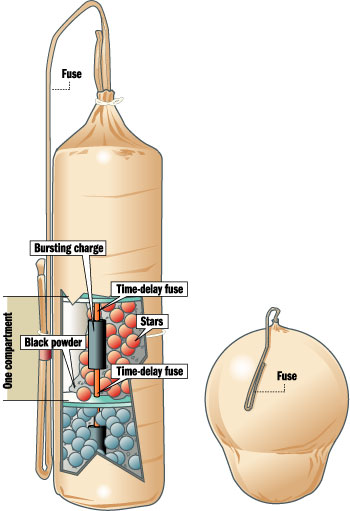
Shells
Robert Noyce, Deseret Morning News Contrary to popular belief, fireworks are not rockets but shells that are propelled with black powder from steel tubes (mortars).
Round shells contain a single display, such as a chrysanthemum, waterfall or ring pattern.
Cylindrical shells (multibreak) contain multiple displays that can produce more random pattern and colors. Some shells can have up to 16 effects.
Screeching and whistling noises are produced by a substance that oscillates as it burns.
Multibreak fireworks contain several cardboard compartments. Bursting charges in each compartment ignite and propel stars through the air.
The more resistant the cardboard compartment is to the explosion, the larger the display.
Explosive sounds are created by placing a sound charge in the shell. This is achieved by adding a mixture of perchlorate to the shell.
Patterns are determined by how stars are positioned in the shell.
Black powder & Stars of fireworks

Black powder
The main component of fireworks is black powder, which is composed of 75 percent saltpeter (potassium nitrate), 15 percent charcoal and 10 percent sulfur.
Stars
Stars are jawbreaker-size lumps of compressed black powder. They produce flashes of color when combined with other chemicals and ignited.
Monday, July 17, 2006
Fireworks: How they work and where they came from---2

Facts
2002 Winter Olympics fireworks display.
Fireworks must be handmade because of the possibility of sparks from machinery. Individuals have to wear all-cotton clothing to prevent sparks from static electricity.
220 million pounds of fireworks were used in the United States in 2003.
The Boston July 4 fireworks display, one of the largest in the country, uses 3.5 tons of fireworks and employs 5,700 mortars to fire them.
The average length of a fireworks display 30 years ago was an hour compared to the current time of 20 minutes.
The Chinese word for fireworks is "yan hua" or "fiery flower."
The display for the 100th anniversary of the Statue of Liberty in 1984 used 40,000 shells on five barges.
· · · · ·
kitchen god

The Chinese believed a kitchen god made annual reports to heaven on a family's behavior. Punishments included a shortened life. Firecrackers were set off to honor the god.
Fireworks: How they work and where they came from---1
The ancient Chinese believed that fireworks' loud bang could scare off evil spirits and ghosts, and eventually, their use was incorporated into all types of celebrations, including births and deaths. European kings valued fireworks so much they appointed "Fire Masters" to provide elaborate shows. England's James II was so pleased with his that he knighted him. Today we celebrate a number of holidays and special events with fireworks. It's ironic, however, that the objects that provide so much visual pleasure also provide the nucleus for one of man's most destructive inventions: gunpowder.
The Chinese believed a kitchen god made annual reports to heaven on a family's behavior. Punishments included a shortened life. Firecrackers were set off to honor the god. History Most historians agree the origins of gunpowder can be traced to ancient China, although some evidence shows the Greeks and the east Indians may have also had some form of black powder by the 8th century. Stories attribute gunpowder's discovery to either a Chinese cook accidentally mixing common kitchen items or an alchemist working to find the elixir of life. By the 10th century, a Chinese monk from the Hunan Province named Li Tian discovered that packing the powder into a paper tube would produce a loud bang. His invention is remembered annually with a celebration on April 18. The province is still a major production center. Firecrackers and fireworks soon gained popularity in religious ceremonies and as a way to celebrate a number of occasions. By the 13th century, Marco Polo and, by some accounts, the Crusaders brought fireworks and black powder to Europe. As the fascination with fireworks grew, so did the development of cannons and guns. The English scientist Roger Bacon (1214-1292), published a formula for producing fireworks or "thunder and lightning." Many European courts were known for their elaborate fireworks displays, including Elizabeth I and James II, who had their own "Fire Masters." Various European families emerged as leaders in such displays. The Grucci, Rozzi and Zambelli families continue the tradition to this day. Fireworks remained relatively unchanged until the 19th century, when chemicals were added for color. There have also been recent improvements in color and visual effects.
The Chinese believed a kitchen god made annual reports to heaven on a family's behavior. Punishments included a shortened life. Firecrackers were set off to honor the god. History Most historians agree the origins of gunpowder can be traced to ancient China, although some evidence shows the Greeks and the east Indians may have also had some form of black powder by the 8th century. Stories attribute gunpowder's discovery to either a Chinese cook accidentally mixing common kitchen items or an alchemist working to find the elixir of life. By the 10th century, a Chinese monk from the Hunan Province named Li Tian discovered that packing the powder into a paper tube would produce a loud bang. His invention is remembered annually with a celebration on April 18. The province is still a major production center. Firecrackers and fireworks soon gained popularity in religious ceremonies and as a way to celebrate a number of occasions. By the 13th century, Marco Polo and, by some accounts, the Crusaders brought fireworks and black powder to Europe. As the fascination with fireworks grew, so did the development of cannons and guns. The English scientist Roger Bacon (1214-1292), published a formula for producing fireworks or "thunder and lightning." Many European courts were known for their elaborate fireworks displays, including Elizabeth I and James II, who had their own "Fire Masters." Various European families emerged as leaders in such displays. The Grucci, Rozzi and Zambelli families continue the tradition to this day. Fireworks remained relatively unchanged until the 19th century, when chemicals were added for color. There have also been recent improvements in color and visual effects.
National Night Out celebration to include parade, fireworks
Festivities will begin with a parade and end with a fireworks display.
NEW MIDDLETOWN — Officials have set the village's annual National Night Out celebration for Aug. 1.
The event has grown each year and an estimated 1,200 hot dogs were served at last year's festivities. Village officials are planning to provide more grills this time to avoid last year's long lines.
The celebration is designed to heighten awareness of crime prevention, generate support for local anti-crime efforts, strengthen neighborhood spirit and the police-community partnership and let criminals know neighborhoods are organized and fighting back.
Police Sgt. Ken Goist, New Middletown's police community coordinator, said residents are asked to lock their doors, turn on outside lights and spend the evening outside with neighbors and police Aug. 1.
Goist said the evening will start with lineup at 5:45 p.m. at Springfield High School for a parade that starts at 6:30 and proceeds to St. Paul the Apostle Church on state Route 170.
Afterward, a cookout and other activities will take place at the municipal building and adjacent Welker Park.
Some of the planned activities include a rappelling demonstration by the Youngstown Fire Department on the village water tower, a Life Flight exhibit, a raffle and music.
At 9:15 p.m. there will be a flashlight walk from the police department to the high school where B.J. Alan will present fireworks at 10 p.m.
Goist said National Night Out, which will be celebrated in more than 10,000 communities, is the nation's largest annual crime prevention event and is sponsored by National Association of Town Watch and co-sponsored locally by the New Middletown Police Department.
NEW MIDDLETOWN — Officials have set the village's annual National Night Out celebration for Aug. 1.
The event has grown each year and an estimated 1,200 hot dogs were served at last year's festivities. Village officials are planning to provide more grills this time to avoid last year's long lines.
The celebration is designed to heighten awareness of crime prevention, generate support for local anti-crime efforts, strengthen neighborhood spirit and the police-community partnership and let criminals know neighborhoods are organized and fighting back.
Police Sgt. Ken Goist, New Middletown's police community coordinator, said residents are asked to lock their doors, turn on outside lights and spend the evening outside with neighbors and police Aug. 1.
Goist said the evening will start with lineup at 5:45 p.m. at Springfield High School for a parade that starts at 6:30 and proceeds to St. Paul the Apostle Church on state Route 170.
Afterward, a cookout and other activities will take place at the municipal building and adjacent Welker Park.
Some of the planned activities include a rappelling demonstration by the Youngstown Fire Department on the village water tower, a Life Flight exhibit, a raffle and music.
At 9:15 p.m. there will be a flashlight walk from the police department to the high school where B.J. Alan will present fireworks at 10 p.m.
Goist said National Night Out, which will be celebrated in more than 10,000 communities, is the nation's largest annual crime prevention event and is sponsored by National Association of Town Watch and co-sponsored locally by the New Middletown Police Department.
Subscribe to:
Posts (Atom)